The independent heating and cooling company across the Willamette Valley and northwest Oregon
No Heat at All
The house is cold, the thermostat is calling for heat, and nothing is happening. Maybe you hear a click and then silence, or the outdoor unit hums but the air from the vents is cool. Before you book a heating repair, there are a few things you can check yourself in about five minutes. Everything past that is our job.
Call (888) 365-6280- You reach a person, not a menu
- Open every day
- The quote comes first, in writing
Taking calls until 5:00 PM PT
By our service team · vetted by the techs who do this daily
What "no heat at all" actually tells us
No heat at all means the call for heat is not turning into warm air, and the cause is usually a break somewhere in that chain: the thermostat, the power supply, the safety controls, or the heating equipment itself. We work that chain in order, cheapest and simplest first, because a dead thermostat battery and a failed compressor look identical from your living room. Pay attention to what the system does when you raise the setpoint. Total silence points one direction. A blower running with cool air points another. A unit that starts and then quits after a few minutes points a third. Tell us which one you hear and we arrive with a shorter list.
Cause family one: the thermostat and the power supply
This is where most no-heat calls end, and it costs the least to rule out. Dead batteries in a battery-powered thermostat will drop the whole system without warning. So will a schedule that quietly switched to a lower setpoint, or a mode left on cool after a warm week. On the power side, a tripped breaker at the panel or a switch flipped off near the indoor unit stops everything. Heat pumps and furnaces both have a service switch that looks like an ordinary light switch, and people flip them by accident. If resetting a breaker works and then it trips again, stop there and call us. Repeat tripping is a fault, not a fluke.
Cause family two: airflow and the safety controls
A clogged filter is a common cause of no heat, and it is the cheapest real repair there is. When a furnace cannot move enough air across the heat exchanger, the high limit switch shuts the burners down to protect the equipment. You get a short burst of warm air, then cool, then nothing. Blocked or closed vents and a collapsed return do the same thing. On heat pumps, a smothered outdoor coil under leaves or snow causes similar shutdowns. Change the filter, open every vent, clear a couple of feet around the outdoor unit. If it still quits after a few minutes, the limit or the pressure switch is telling us something and we need to read it.
Cause family three: ignition, defrost and refrigerant
Now we are into work that needs tools and training. On a gas furnace, a failed igniter, a dirty flame sensor, or a blocked flue means the burners never light or shut off seconds after they do. On heat pumps, which is most of what we see across Oregon and Washington, wet winters make defrost boards, reversing valves and sensors the usual suspects. A system that ices over and never clears is a defrost problem, not a cold snap. Low refrigerant from a leak also shows up as weak or no heat. None of this is homeowner work. Gas, refrigerant and high-voltage components stay with us, and we do not recommend opening panels to look.
If you smell gas or a carbon monoxide alarm sounds
Leave the building first. Take everyone with you, do not flip switches or use anything electrical on the way out, and once you are outside call 911 or your gas utility from a safe distance. After that, call us and we will come look at the system. This is the one part of a no-heat call where speed matters more than diagnosis. A rotten-egg smell near a furnace, a hissing sound, or a CO alarm that goes off and stays off are all reasons to be outdoors, not troubleshooting. Nothing about your furnace repair is worth staying inside for. We would rather drive out to a false alarm than the alternative.
What a technician does differently
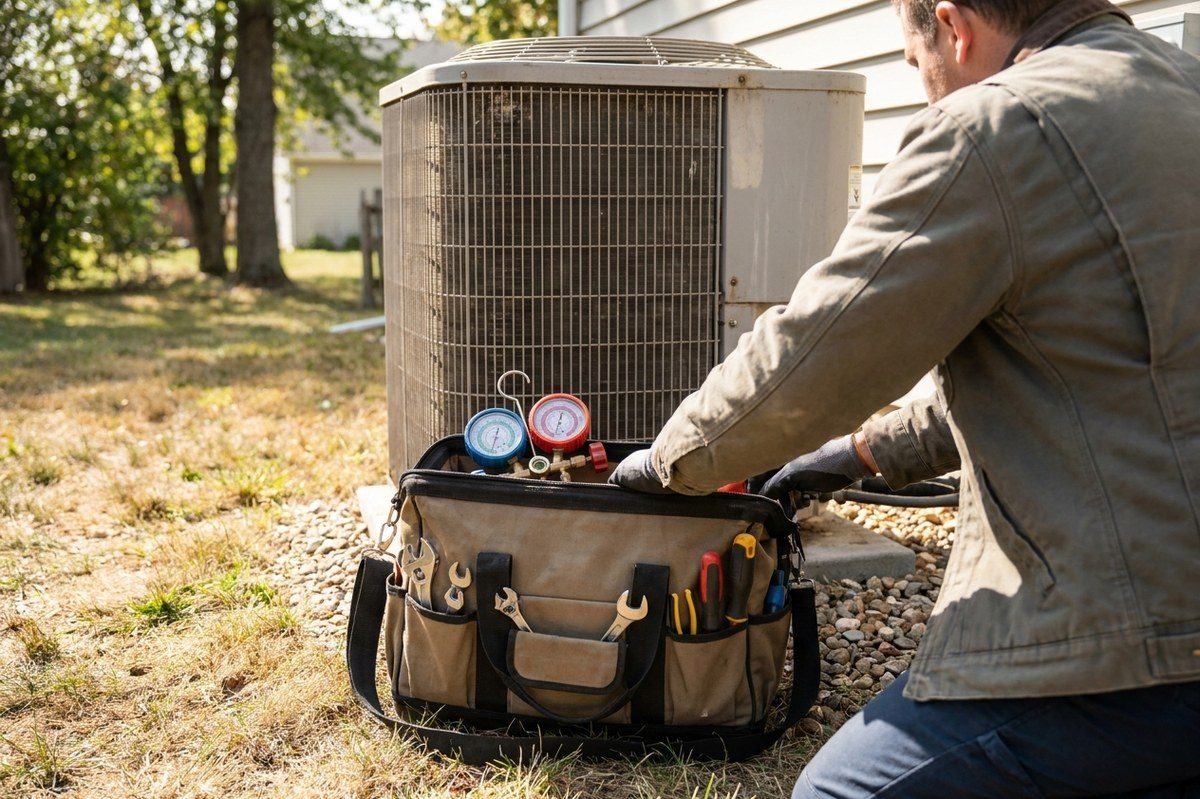
We meter it instead of guessing. On a no-heat call we check voltage at the board, read the fault code the equipment is storing, test the igniter and flame sensor under load, and put gauges on a heat pump to see what the refrigerant is actually doing. We also check static pressure, because a system that keeps hitting its limit switch usually has a duct or filter problem behind it, and swapping a part without fixing that just buys you a few weeks. Then we tell you what failed, what it will take, and what else is close to the end of its life so you are not surprised in February. Same approach whether it is heating repair or air conditioning repair in July.
No Heat at All — fast answers
My thermostat screen is blank. Is that the thermostat or the furnace?
Could be either. Start with fresh batteries if it takes them. If the screen stays dark, check for a tripped breaker and the service switch near the indoor unit. Still blank after that, a control board or transformer has usually failed and we need to test it.
Should I keep resetting the breaker to get heat overnight?
No. A breaker that trips once may be a fluke, but a breaker that trips again is protecting you from a real fault, usually a shorted motor or wiring. Use space heaters safely for the night and let us find the cause first.
My heat pump is blowing cool air but the fan runs. What is wrong?
Often a defrost problem, a reversing valve stuck in cooling, or low refrigerant from a leak. It can also be a thermostat left in cool mode, so check that first. Everything else needs gauges and a technician.
How it works
- Step 1
Tell us the symptom
Call or fill in the quote form. Describe the noise, the smell, the temperature, and when it started. That detail helps us bring the right parts and gives you an honest idea of the visit ahead.
- Step 2
We diagnose on site
A technician checks the thermostat, airflow, electrical connections, refrigerant behaviour and the outdoor unit. We tell you what failed and why, in plain language, before anyone reaches for a part or a price.
- Step 3
You choose the repair
We lay out the fix, any parts on order, and what happens if you wait. Once you agree, we do the work and confirm the system holds temperature before we pack up and leave.
- A real person answers
- Open 7 days
- Written quote before work starts
Why homeowners call us
- Heat pumps are our normalIn this region heat pumps outnumber furnaces, so defrost boards, reversing valves and short cycling in wet weather are everyday work for us. We know how these systems behave in a cold December rain, not just on a test bench.
- Wet winter defrost problemsIce on the outdoor coil, a unit that runs and runs without warming the house, puddles that refreeze under the pad. We trace whether it is a sensor, a stuck valve, drainage, or airflow, then fix the actual cause.
- Filtration after smoke seasonWildfire smoke turned indoor air quality into a real conversation here. We look at filter fit, return sizing and IAQ options that your blower can actually push air through, rather than choking the system with the wrong media.
- We explain before we chargeYou get the diagnosis, the options and the trade-offs before work starts. If a repair is not worth it on an old system, we say so. No pressure, no jargon dumped on you at the door.
- All major brands, gas & electricOne independent crew for Carrier, Trane, Lennox, Goodman, Rheem and more.
- Straight answersNot worth fixing? We say that out loud, and often it saves you the visit fee.
About this guide
Checked everything on the list and it still acts up?
Tell us what you tried and what it did. The booking itself takes a minute.
- A real person answers
- Open 7 days
- Written quotes
- All major brands
- Gas & electric
Rather not call? Get a free quote →